Image Description: a closeup of dandelion fluff, or pappus, that carries the seeds.
Assessments and Consultations are available, scheduling 4-5 months in advance.
Dr. Ferguson is full for therapy clients.
In-person sessions and serving all of California via Zoom
Neurodiversity-Affirming* Assessment, Diagnosis, Therapy, Advocacy
Spark Psychological Services
Laurie Ferguson, Psy.D.
Licensed Clinical Psychologist*
Laurie Ferguson, Psychologist, Inc.
Philosophy
My grandfather was a machinist and tinkerer, and his garage was filled with things that needed fixing -toasters, car engine parts, radios. I was fascinated by his skill in turning sheets of metal in to things that were useful and beautiful. He made things run smoother, and he saved things that others thought were beyond repair. I approach psychological services in much the same way, with the idea that nothing is "beyond repair" and school, work, home life, and relationships can be more fulfilling and run more smoothly. Neurodivergent people do not need "fixing," and services are provided from a neurodiversity-affirming perspective.

Support and Strategies,
Not Judgment
It takes a lot of courage to make the call to a psychologist. I consider it a privilege to become part of your or your loved one's support team. My style is interactive, directive when it can be helpful, and non-judgmental. Only you can truly understand what it is like to walk in your shoes. Parents and caregivers are crucial to working with teens and children. While respecting confidentiality laws and a child's or teen's privacy, I make parents an integral part of the process whenever possible.
photo description: red and green vintage radios made of Bakelite, a type of synthetic plastic used in the 1940's.

You Are The Driver
My grandmother drove an old white station wagon with fins and bright red "pleather" seats. She absolutely loved to drive, and I remember the feeling when I took the wheel of my first car, one that my grandfather fixed up - a junkyard Ford Pinto that he spray painted bright yellow to cover the Bondo filling the dents. Pure bliss.
You are the driver in your therapy or assessment. You and I work together as a team on your goal. I coordinate with your physician, school, and others as needed. If I think that another professional is needed, then I get you connected with that provider.
photo description: closeup of a steering wheel from vintage Chrysler car with a teal painted dashhboard.

A Whole Person,
Not "Just A Diagnosis"
I still have the Polaroid camera I bought as a teenager. Magic. A moment caught in time.
Likewise, a diagnosis does not capture all of you. You or your loved one is more than a label in a medical chart. What a diagnosis may do is open doors to school supports or agency services. A diagnosis can be affirming and validating as you seek to understand your own way of processing information and social relationships.
When we conduct assessments or work in therapy, we are looking at a moment in time. A snapshot. I am a firm believer in the idea that the past does not have to dictate our future.
photo description: A Polaroid LM 630 camera held up in front of a blue sky with pale clouds.
Services
Assessment, Diagnosis, Therapy, Advocacy

Assessment & Diagnosis
Help your loved one reach their potential.
Dr. Ferguson specializes in assessment and diagnosis of Autism, ADHD/ADD, anxiety, OCD, panic, depression, and other concerns for children, teens, and adults. Kids can be bright but still have trouble in school. Adults can be motivated and hard working, but can have trouble in relationships, work, or in living independently. Maybe you have always thought that something is different for you or your family member, or maybe this is something new. Let's figure it out and prioritize well-being. Dr. Ferguson is a privately-contracted assessor for Tri-Counties Regional Center, school districts, attorneys, and families. Evaluations can be completed for supports in school or college, for Social Security benefits, or for your other providers who need more information to better serve you. Click on the Assessment tab above to learn more.
Photo description: boy in a hat looking up at airplane contrail against a blue sky with Morro Bay, CA in the background. Photo credit: Laurie Ferguson

Therapy for children, teens & adults
What are your goals?
Research-based interventions are the foundation of Dr. Ferguson's work, individualized to fit each unique client. This often means modifying traditional approaches to be neurodiversity-affirming. Sessions can be over zoom, phone, in-person, or "walk and talk" sessions around the nearby Sunken Gardens. Play therapy helps children to talk about emotions, coping, and getting better. Sometimes art therapy helps teen explore identity, relationships, goals, and stress resilience. Managing anxiety and mood, improving self-advocacy, and developing positive self-esteem are common reasons that individuals of all ages come to see Dr. Ferguson. Adults may also come in to learn about Autism or other aspects of neurodiversity for themselves or a loved one.
Photo credit: Xavier Bailey Photography. Photo description: a wooden sailboat on the ocean with the sun shining behind the sail.

Advocacy
Ever feel like you are going around and around, getting nowhere?
"Systems" can be confusing - schools, courts, Regional Center, Social Security, insurance, agencies - What do they do? How do you qualify? Where do I start? Many families are not aware of the possible services they may be eligible for. It can feel like going to a restaurant without a menu. Often, parents believe that the school will identify any learning issue early on, and offer support. Every organization is limited by the things that limit us all -- time, staff, and money. Families need to become their own advocate, and Dr. Ferguson can support you, providing guidance, realistic advice, and assessment or therapy services as needed.
Photo description: Tilt-a-whirl ride at the California Midstate Fair, shot from below with people swinging out against a blue sky, Paso Robles, CA, photo credit Laurie Ferguson
Diversity is Celebrated
People of all backgrounds are welcome in my office, including all racial, ethnic, religious, political, gender identity and gender expression, sexual orientation, socioeconomic backgrounds, and neurodivergent* individuals.

Image Description: A signpost in New York City near the historic Stonewall Inn with a brown sign that reads Gay Street, a purple sign that reads Lesbian Street, dark blue sign that reads Bisexual Street, a light blue and pink and white sign that reads Trans Street, a turquoise sign that reads Queer Street, a green sign that reads Intersex Street, a yellow sign that reads Asexual Street, an orange sign that reads Nonbinary Street, a red sign that reads Pansexual Street, a hot pink sign that reads Two Spirit Street, and a black sign that reads Plus Street using a plus symbol.
- Photo taken by Laurie Ferguson, 2019.
*What is Neurodiversity and Neurodivergence?
Neurodiversity encompasses the many ways we as human beings think, act, and relate to others. This can be a neurotypical style (what society tells us is average, "normal," or typical) or a neurodivergent style (different from that "average"). These differences are thought to be neurologically-based, not the result of parenting, practice, or training. Neurodivergence describes neurologically-based differences that include Autism, ADD/ADHD, many forms of anxiety (including OCD and panic), learning differences, certain personality features, bipolar and other mood changes, sensory processing differences, epilepsy, and more. People who are neurodivergent are much more likely to identify within the LGBTQIA+ community. The neurodiversity community values social justice, inclusion, and support so that neurodivergent individuals can live full lives free from discrimination. While neurodivergent people may act or behave in neurotypical ways, this masking can be exhausting and take a toll.
Your experience
Neurodivergent individuals are often stigmatized and may be reluctant to seek help, diagnosis, or support. BIPOC and LGBTQIA+ folx experience multiple facets of marginalized identities. It is my job to understand and support you, so that you can reach your goals. While I will ask you about your unique background and experiences, I do not expect you to be my educator where systemic discrimination is concerned - it is my job to stay educated. I was thanksful to participate in the SLO ACCEPTance Project training to better support the mental health needs of the LGBTQIA+ community.
Allyship
Therapists can be effective allies and advocates, working to change the systems that perpetuate inequality. Rebuilding our institutions to be more inclusive, helpful, efficient, and affordable for everyone has fallen disproportionately to groups with the fewest resources to make those changes. Those with access and privilege need to do their part. I was on the Board of Directors of the Central Coast Autism Spectrum Center for 9 years, and was the Ethics Chair for the Central Coast Psychological Association. An integral part of my work is advocating for clients in school or college, with the Regional Center and Social Security, and in their work place.
Autism

Photo Description: Hillside in the spring covered with yellow mustard flowers and a live oak tree bent from the wind. Oaks do an incredible job adapting to environmental demands. Photo credit: Laurie Ferguson, Poly Canyon, San Luis Obispo, CA, 2016.
Kids, Teen, Adults, and "high-masking" individuals are welcome. It is never too late to learn about yourself.
There are two options for learning more about possible Autism for yourself or a loved one: a formal assessment, or the Autism Exploration Consultation. Click here to learn more and see below for more information Autism.
Autism is as unique for each individual. You might see common characteristics of Autistic people, ADHDers, and people with sensory processing or learning differences. When supports are needed, such as with improving communication, learning, independent living skills, and social relationships, it is crucial to also preserve and celebrate who you are.
Do Autistic people have a "disorder," or is it a failure of our society to support the diversity of human experience? Is the disorder actually in society itself? Many people in the Autistic community feel that the way Autism is currently assessed and "treated" results in further marginalizing people who are already vulnerable. When you come to Dr. Ferguson for a diagnostic assessment or for the Autism Exploration Consultation, you are seen as a whole person, not just a collection of symptoms and behaviors. Your strengths and skills are part of what makes you unique, and some in the Autistic community feel it is Autism that enhances those skills.
An assessment for Autism includes what we used to call Asperger's (some people refer to this as "high-functioning" Autism, although these labels regarding level of functioning obscure both challenges and strengths, and the Autistic community sees functioning labels as ableist). Perhaps you are looking for support for issues related to job difficulties, college, relationships, parenting, or independent living. Succeeding in these areas can sometimes be more challenging if you are Autistic, while you also have unique strengths. Masking, or covering up your Autistic traits to appear more neurotypical, can lead to exhaustion and burnout. Sometimes it is more important for the environment to change, rather than you. Becoming your own self-advocate is important so that you can feel comfortable voicing your needs.
Autistic individuals largely prefer the term "Autistic," as it is part of their identity and it is a big part of who they are. You can't take it off like a jacket. The earlier "person first" movement ("person with autism") was well-intentioned and meant to highlight that everyone should have the same rights. But now many in the Autistic community want to stress that Autism is central to their identity, preferring "identity first" language ("Autistic person"). Bottom line, it is up to the individual. Just ask!
Email Dr. Ferguson for assessment details or questions. Please be yourself and let Dr. Ferguson know what works for you and doesn't work for you (is email more comfortable than a phone call? Do you prefer zoom?). Dr. Ferguson wants to make you as comfortable as possible. She will review your goals for assessment and any questions. You are welcome to bring a family member or friend with you to the assessment, and support animals are welcome. Your information is kept confidential, and is only released with your written consent, even if someone else pays or makes the appointment for you. Dr. Ferguson communicates in a clear, straightforward, respectful, logical, solution-focused manner to help you achieve your goals.
ADHD / ADD

Photo description: Union Square and Maiden Lane criss-crossed with string lights in San Francisco, CA at night. Photo credit: Laurie Ferguson, 2021.
No, you're not lazy or unmotivated.
One day she finishes things well, and the next day it's hard or even impossible. Think of ADD / ADHD like a bank account. It takes time to save up for the next task. It's not because she can't do the task, it's because she can't always do it when required. People with ADD or ADHD get mislabeled as "lazy," "oppositional," or "unmotivated." If it goes on too long, those negative labels are easier to believe about yourself. We can help before that happens.
ADD / ADHD is a brain-based neurological difference. Productivity, organization and attention will be inconsistent, so sometimes things go well and other days can feel like starting over. This is not due to lack of motivation or willfully not taking care of responsibilities. Emotional and behaivoral regulation can be very difficult. But success is possible.
People with ADD and ADHD are often creative, out-of-the-box thinkers who can focus intensely on their passion. They are paying attention -- just not to what other people think is a priority. These are great qualities in entrepreneurs and inventors, but not so much for students trying to graduate and employees who have work due. We can assess whether it is ADD / ADHD or something else, so they have proper supports.
Everyone is different, and supports will be too. Maybe you require more time on tests, a quieter room for test-taking, help organizing assignments, note-taking help in college, priority registration, tutoring or small-group instruction, or a reduced work load. At work, strategic breaks, working remotely or in a quieter setting, improving planning and organization, and individualized work schedules may help. Understanding what your unique needs are to keep you optimally alert (not over-energetic, not too relaxed) can improve your studying and work pace. Maybe insomnia, anxiety, depression, stress, or medical issues are exacerbating issues. A solid assessment, treatment plan, and effective strategies for your unique situation can get you on track.
Anxiety and OCD

Photo Description: Small, cozy cabin in a meadow surrounded by a cedar forest with mountains in the background.
Make it work for you instead of against you.
Maybe you avoid crowds, parties, or school / work events. This can be due to sensory factors, the environment, and / or social expectations. But if your world is slowly shrinking in ways that aren't working for you, then you might feel socially isolated, school or work becomes harder, or self-esteem suffers. Panic can be scary and exhausting. Obsessive-compulsive symptoms might be controlling how you do certain things. That elusive "just right" feeling becomes more and more difficult to obtain. It can seem impossible, but anxiety, panic, and OCD are very treatable.
A note on introversion -- it's normal! In fact, some researchers think there are more introverts than extroverts, even though society rewards those who are the life of the party. Introversion is not necessarily problematic and may not need treatment - unless it's causing you stress and holding you back in relationships, work, or school. Sometimes, having a mis-match between your introverted nature and your environment can cause anxiety. Many introverts tell me their ideal environment is a "cabin in the woods," but they need to function in a busy home, school, or office. Through proper assessment, we can figure out what is going to help you to feel most at peace.
Working on anxiety can be... anxiety-provoking. Change is hard, until it becomes too unbearable to continue old patterns. You decide how fast to go. Together, we will set goals, make a plan, and help you lead a fuller, more peaceful life. Treatments known to work are used, including empirically-validated cognitive behavioral therapy, exposure and response prevention, and acceptance and commitment therapy - all individualized to your needs and your neurotype.
Learning Differences

Photo Description: Student with dark hair, glasses, and striped shirt reading a book with a black cover
What is a learning disability? What about learning differences?
A learning difference means that you learn differently from the "average," and supports may be helpful for you to succeed and meet your potential in school and work. Advocating for yourself or a loved one may be challenging if you don't know what to ask for. Supports may be available in school or college, work (ADA accommodations), job training, Social Security, the Regional Center, or other services.
There are many different ways of learning. Some people are visual learners, others need to hear information to remember it, others are hands-on (kinetic) learners. If you have Dyslexia (a reading disability), this can affect math too, such as word problems. A learning disability in math (Dyscalculia) may mean you also have trouble with telling time, reading maps, and understanding left/right. A Non-Verbal Learning Disorder (NVLD) may mean that you have trouble understanding communication that isn't verbal, such as reading facial expressions, body language, and other social cues.
Some individuals have challenges with executive functioning, which is the ability to organize, plan, prioritize, start and finish tasks, control impulses, regulate emotions, and keep working even when it is boring or hard. Sometimes these challenges include a slower than "typical" processing speed, so homework and chores might take a lot longer. One day someone may finish tasks and be on top of things, and another day things fall through the cracks. These differences may be brain-based, not because the person is "just lazy" or "unmotivated."
Dr. Ferguson screens for learning differences and related concerns like executive functioning in all of her assessments.
Assessment
Proper assessment gives you a roadmap, direction, and knowledge about yourself. Diagnosis isn't a label - it's a key to open the door to services and / or self-acceptance.
Photo Description: A clover-leaf freeway interchange lit up at night with multiple off-ramps and surface streets.
Why Dr. Ferguson?
Dr. Ferguson uses research-based, standardized assessment tools for diagnostic evaluations, and she includes in-depth conversations from a neurodiversity-affirming perspective to understand you as a three-dimensional human being - not just test scores. Depending on age and needs, we can meet over telehealth (zoom) or in person. She will include specific tests that might be required by the services you are applying for, and she uses a neurodiversity-affirming approach while maintaining validity. Dr. Ferguson completes all aspects of the assessment process herself to ensure quality at every level. You receive a report explaining results using clear, understandable language. This report can help you apply for services and supports, if eligible.
Every assessment includes screening for a wide variety of related concerns, including learning differences or disabilities, ADHD, anxiety, depression, obsessive-compulsive experiences, social relationships, stress, sleep problems, mood disorders, sensory issues, auditory and information processing, planning and organizing abilities, speech and language skills, fine and gross motor skills, trauma, and other concerns.
The first meeting with Dr. Ferguson is two hours, which actually flies by since there is so much to talk about. There are lots of toys to keep younger children busy. The client attends (along with a caregiver if the client is a minor). For adult clients, you decide who comes to the assessment - even if someone else is paying. We discuss development, medical conditions, school/college/work history, social relationships, mood, behavior, sleep, likes/dislikes, and goals for the assessment. There are questionnaires to fill out and bring to the meeting. The report is usually completed two to four weeks following the last assessment session. We will have a feedback session to go over all results and recommendations in understandable language and answer any questions.
See the Fees tab for more information.
To set up an assessment or for questions, email Dr. Ferguson's office. She will review your needs and your goals for assessment. Please be yourself!
Fees

Image Description: Seagulls flying over the ocean as the sun sets off the California coast.
Autism Exploration Consultation $400
In a one-hour consultation, we focus on whether Autism may be a fit for you. This is not a diagnostic assessment and no report or diagnosis are provided, so this would not be sufficient for college or job accommodations, educational supports in K-12th grade, regional center supports, or social security applications (scroll below for formal assessments and report options). We also explore whether Autism and/or other ways of being neurodivergent (such as ADHD, sensory processing, anxiety, etc.) may be a fit. We talk about resources, recommendations, and whether formal assessment would be helpful for your goals. If you know a formal assessment is needed, you can begin that process without a consultation.
Consultation $400
In a one-hour consultation, we talk about your concerns and develop a plan to help you reach your goals. There are multiple types of assessments and therapies, and I will be able to advise you if a referral to another professional or service is needed (occupational therapy, speech and language therapy, IEP or 504 Plan through the school district, tutoring, educational therapists, job coaches, psychiatry). Navigating these "systems" can be confusing, and together we can develop a road map. There IS such a thing as "too much therapy," and families do not have unlimited time and resources, so I can help you prioritize services. If you desire follow-up consultation or therapy, fees are $200 for a 45- to 50-minute session, and $250 for a 60-minute session.
Diagnostic Assessment of ADD/ADHD and Mental Health - starts at $1800
Together, we will assess ADD/ADHD and mental health concerns (anxiety, panic, OCD, depression and bipolar concerns, trauma), sensory processing, and behavioral concerns. Screening for Autism and learning differences is also included, but further testing would be needed for diagnosis (see below for Autism assessment). For school supports (an IEP or 504 Plan), Social Security, or the Regional Center, these agencies/systems may need to conduct their own testing to determine your eligibility. This assessment is sufficient for those seeking supports in college or ADA accommodations at work. Fees begin at $1800, including testing, feedback, and comprehensive report. If additional testing is needed, the fee is $400 per hour.
Diagnostic Assessment of Autism, ADD/ADHD, Mental Health, and Related Concerns - starts at $3000
This testing includes everything in the ADD/ADHD testing above, as well as diagnostic testing for Autism. This is an ideal option for individuals who want clarity on diagnosis, strategies that can help improve school and work, and information about their unique patterns of thinking and communicating. Fees begin at $3000, including testing, feedback meeting, and comprehensive report. If additional testing is needed, it is $400 per hour.
Therapy, College and Career Counseling, Life Transitions
Relationships, college, careers, and other life transitions can be easier with a supportive therapist. Executive functioning, anxiety, or depression may benefit from targeted strategies. All therapy starts with a 60-minute intake, which is $400. We talk about what has worked and not worked in the past, and we will make a plan to help you reach your goals. Follow-up therapy sessions are $200 for 45- to 50-minute sessions. A 60-minute session is $250.
Professional Consultations and Trainings
For clinicians, teachers, supervisors and allies who want to learn more about Autism, ADHD, learning, executive functioning, trauma, behavior, sensory differences and more through a neurodiversity-affirming lens. Individual case consultations or trainings are $400/hour (or share the cost between 2-3 colleagues). There are a variety of small and large group consultations and training seminars for you or your organization that are an affordable way to build a professional network while learning. See Seminars for current offerings.
Forms & Helpful Info

Image description: A man wearing a faded red shirt and carrying a backpack is walking in front of a mural painted on a brick wall that says Good in blue script writing.
To confirm your appointment with Dr. Ferguson:
1) Email Dr. Ferguson (use the Contact tab) to discuss your needs
2)You will be emailed a link to complete the Intake Forms through a secure, HIPAA-compliant link.
3) Below is HIPAA Privacy Information for your records.
Your appointment is not confirmed until the steps above are complete.
Do not send Intake Forms without first making an appointment with Dr. Ferguson.
Gallery
Check out what the office looks like
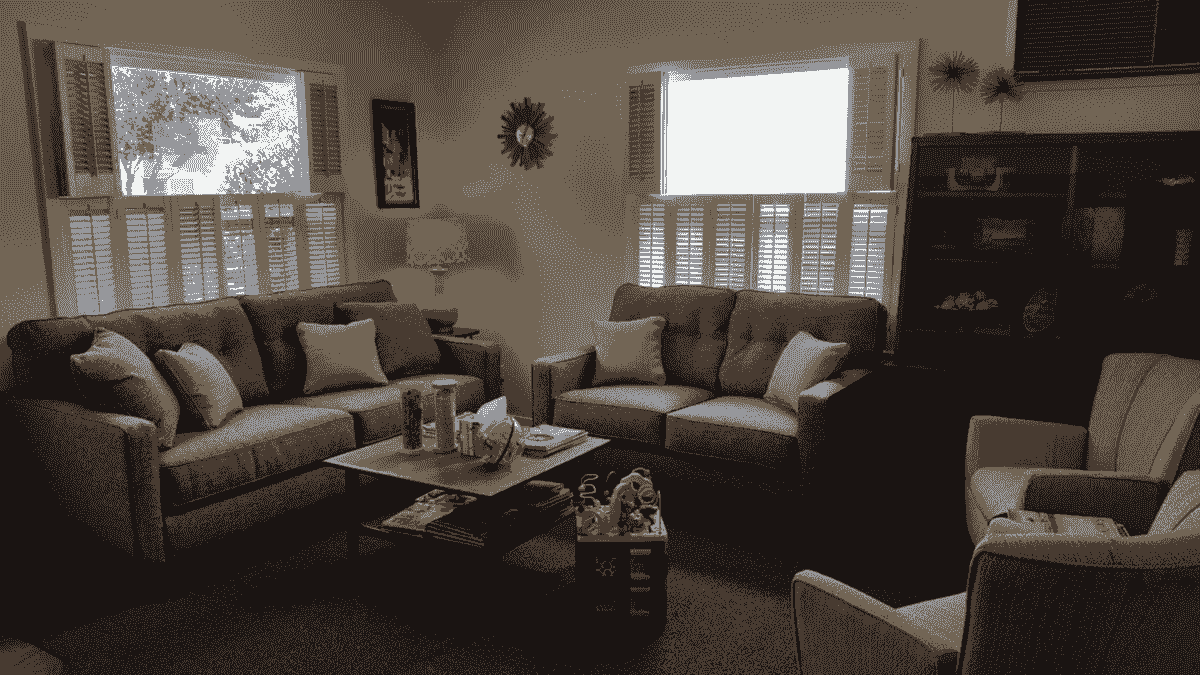
Waiting room
get cozy
lots of places to sit with books and toys
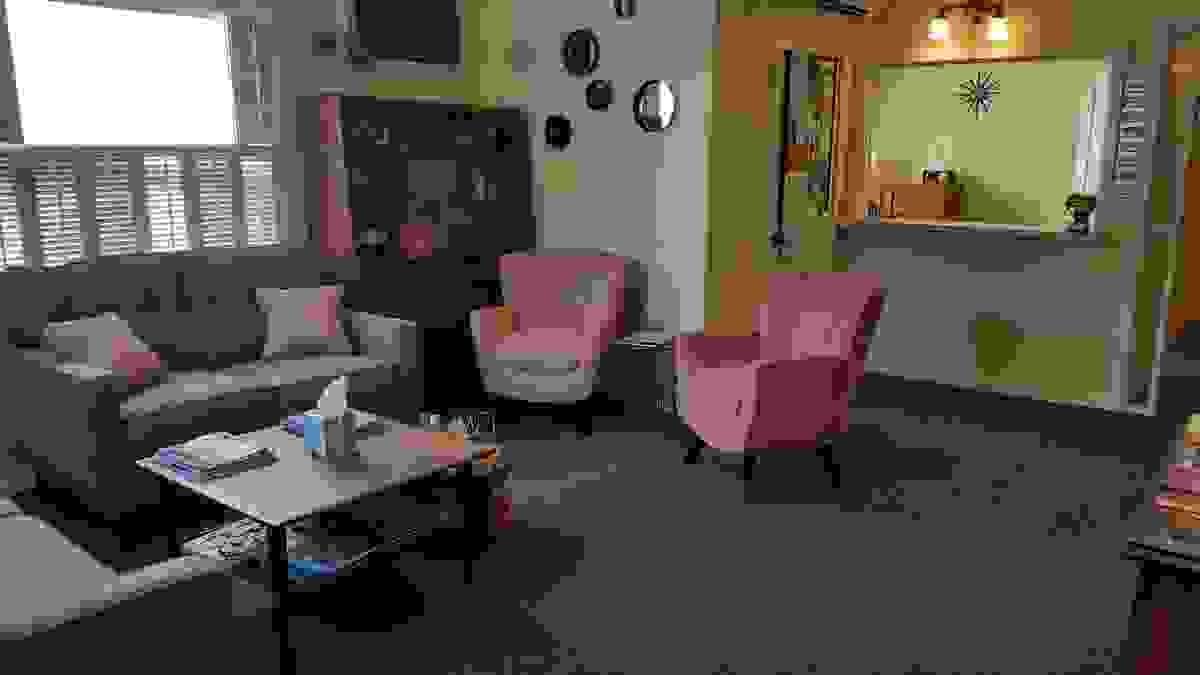
Waiting room
get connected
free Wifi while you wait
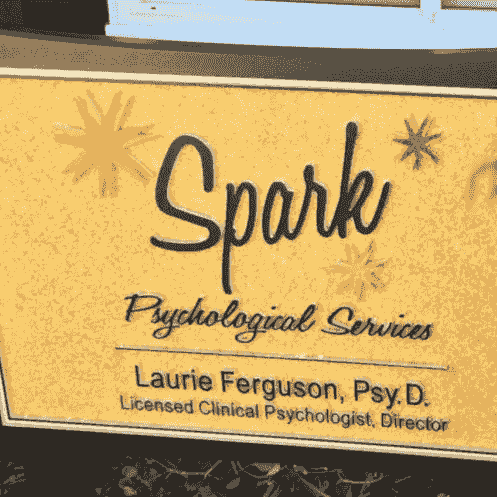
Office sign
look for the yellow sign with bright starbursts
Spark Psychological Services

Have fun
therapy doesn't have to be a drag!
toys and games helps kids look forward to therapy sessions
(photo is not a client; photo credit: Laurie Ferguson)

Image Description: Two dogs in a zoom meeting discussing the merits of bones versus dog biscuits.
The Yorkshire terrier is a fan of dog biscuits and the French bulldog swears by bones.
ZOOM LINK
If you have a scheduled appointment, click Zoom Link above to go to Dr. Ferguson's waiting room. If you have a scheduled appointment, you will be let in to the meeting.
Zoom Meeting ID: 805 610 8694
Passcode: spark
About Dr. Ferguson
Licensed Clinical Psychologist
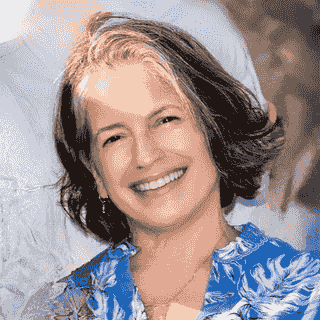
Laurie Ferguson, Psy.D.
(she/her)
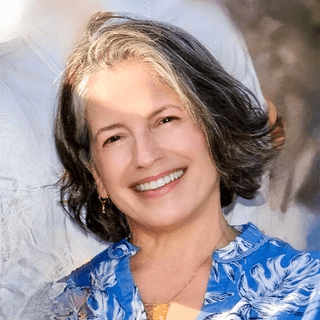
Photo description: PIcture of Dr. Ferguson wearing blue shirt and red and blue flowered shawl, standing in front of columns in Balboa Park, San Diego.
Photo Credit: Xavier Bailey Photography
My approach is honest, respectful, solution-focused, and based on understanding your strengths. I use techniques grounded in research and best-practice guidelines. All Diagnostic Assessments are completed entirely by myself using assessment tools widely recognized and accepted by the mental health and neurodiversity-affirming communities. I do not use AI technology in report writing, notes, or client records.
I have been working in the mental health field helping children, teens, families, and adults since 1996. In 2002 I obtained my doctorate in Clinical Psychology from The Wright Institute in Berkeley, accredited by the American Psychological Association (APA). Training included an APA-accredited internship at The Children's Hospital in Denver, and a fellowship at the National Jewish Medical and Research Center in Denver (now called National Jewish Health). Training also included clinical positions at the San Francisco Department of Public Health, the USF Child and Family Center, and other out-patient and in-patient settings. Before attending graduate school, I was a mental health worker for the psychiatric units at the San Francisco County Jail and St. Mary's Medical Center in San Francisco. Additional training included the SLO ACCEPTance Project, and I am proud to provide mental health services to the the LGBTQIA+ community.
What is psychologist? In the state of California, it requires a doctorate degree (Psy.D. or Ph.D.) that includes supervised practical experience and training, a dissertation, and an additional 3000 hours of supervised experience after coursework is completed. Then a comprehensive licensing exam is taken. Once licensed, psychologists must continue to learn and gain experience in order to renew their license. Psychologists adhere to strict ethical and legal guidelines that are managed by the California Board of Psychology. Psychologists in California are doctors in that they have a doctorate degree in psychology, but they are not medical doctors and they are not licensed to prescribe medication.
I truly believe that lived experience is crucial in your clinician or consultant. This can help reduce the impact of neurotypically-centered societal norms that can impede a client's progress. I live in a family of multiply neurodivergent individuals that includes Autism, ADHD, learning and sensory processing differences, and other experiences. I am also neurodivergent myself.
I am proud to support the Central Coast Autism Spectrum Center in San Luis Obispo, where I was a Board Member for 9 years. I have been a PTA member with my children's schools. I am also a member of the Central Coast Psychological Association, where I was previously the Ethics Chair.
My office is located on Chumash and Salinan native land. A portion of proceeds has supported the Chumash Heritage National Marine Sanctuary and other local non-profit organizations.
In my spare time, I love to travel, hike, garden, and enjoy the beautiful Central Coast with my family. Architecture and art are particular interests.